
68% of Students Feel Day-1 Ready. Only 9% of Employers Agree.
Published 18/09/2026 · Re-checked and updated 29/10/2026
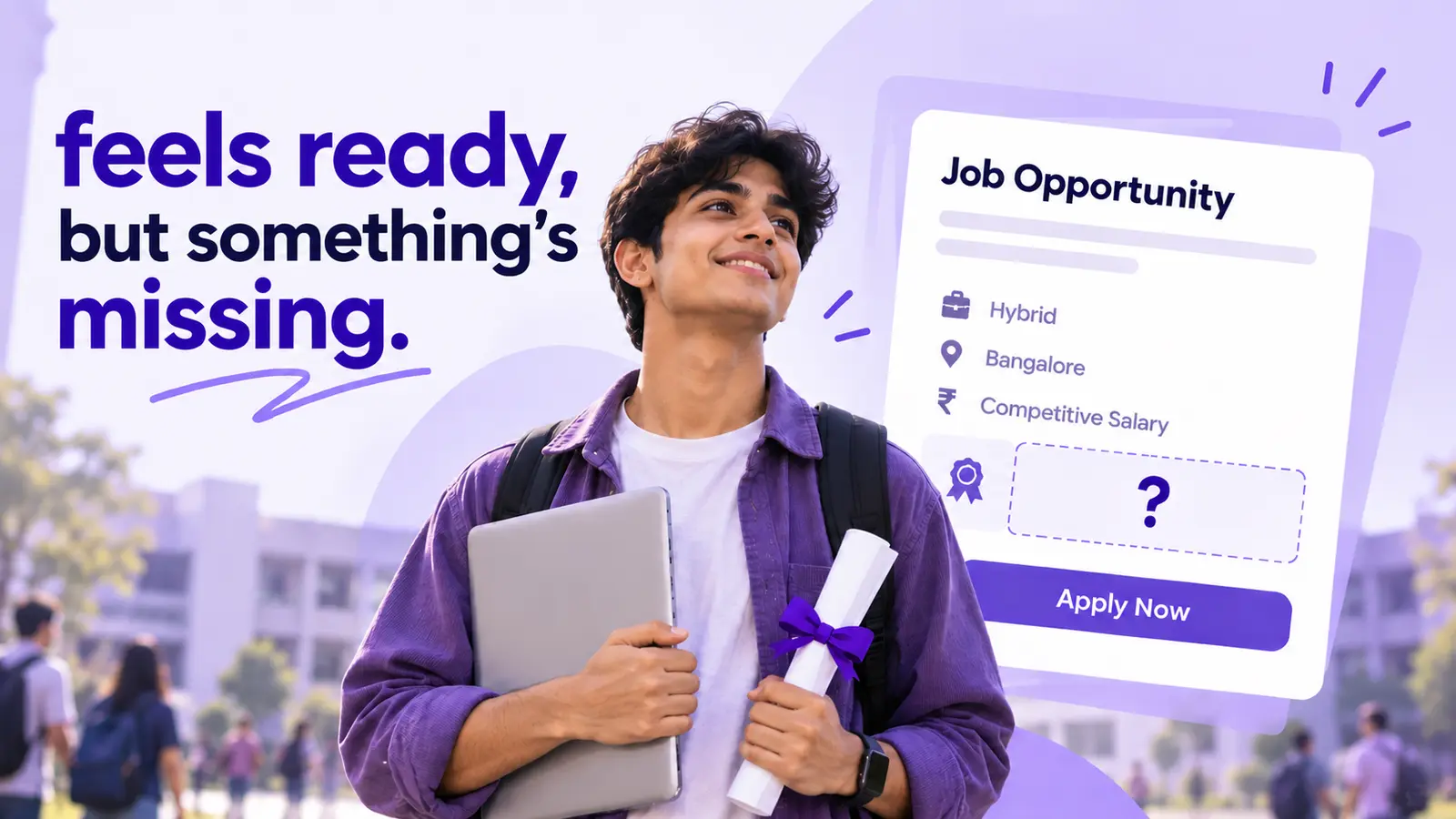
You feel ready.
You’ve done the degree, the projects your college asked for, maybe a certificate or two. You can talk about skills and “AI” in an interview without freezing.
Then the job description still asks for something you can’t point to in thirty seconds — and the offer doesn’t come.
That gap isn’t only in your head. It’s in the numbers.
HirePro’s State of College Hiring in India 2026 surveyed more than 10,000 students, 100 colleges and 80 companies. It found that 68% of students say they’re Day-1 ready. Only 9% of corporates agree. And 51% of companies still let CGPA influence who gets hired. The gap is about proof of skills — not missing ambition.
So the story isn’t “students aren’t trying.” It’s that confidence and hireability stopped being the same thing.
Students say yes. Employers mostly don’t.
What “Day-1 ready” actually means to employers
Colleges often talk as if skills-first hiring already won. HirePro’s picture is more awkward: only 21% of companies say they’ve fully switched to skills-first hiring, even while many campuses believe the shift is done.
In practice, recruiters still buy a mix of:
- Evidence they can trust quickly (projects, internships, apprenticeships, competitions)
- Learning agility — can you pick up the stack, the tool, the customer problem?
- Fit for a specific role family — not “open to anything”
Three things, in the first 30 seconds
“I’m learning AI” is a vibe. A small shipped project, an apprenticeship write-up, or a clear before/after from an internship is proof.
For parents

If your child has a degree and still isn’t converting, it doesn’t automatically mean they’re careless — or that “there are no jobs.” It often means the plan stopped at credentials while hiring moved toward proof for a narrower set of roles.
A simple readiness audit (no panic required)
You don’t need a life overhaul. You need a clearer signal.
Do this for two weeks
- Step 1One role clusterA primary and a backup
- Step 2Two proof piecesThings a stranger can trust in 30 seconds
- Step 3One practice loopMock interviews and applications in that role family
1. One role cluster Name a primary and a backup (for example: ops / customer success, or data-adjacent analyst — whatever fits this student, not the loudest LinkedIn trend). If the answer is still “any job,” there isn’t a plan yet.
2. Two proof pieces What can a stranger trust in thirty seconds? A project link. An internship outcome. An apprenticeship. A competition case. Something visible — not a promise to learn later.
3. One practice loop Mock the interview for that role. Apply in that role family — including off-campus. Off-campus isn’t a consolation prize anymore; for a lot of Gen Z graduates, it’s the main road.
Do that for two weeks and you’ll know more than another month of “applying everywhere.”
What usually closes the gap
| What students often do | What tends to convert better |
|---|---|
| Collect certificates | Ship one artifact for one role |
| Apply to everything | Apply inside a role cluster |
| Wait only for campus drives | Mix campus + off-campus + warm intros |
| Talk about AI in general | Show one AI-adjacent (or role-adjacent) proof |
The fix is rarely “another random coaching class.” It’s a skills + role roadmap — clarity first, then a path you can see week by week.
A quieter close
If this framed something you’ve been feeling — student or parent — that’s enough for today.
Sources
- HirePro, The State of College Hiring in India 2026 (research report page)
- HirePro, Skills over degrees: Is India’s hiring system ready to make the shift? (68%, 9%, 51% and 21% figures)